Blog 8: In Space Manufacturing

Over the past two semesters I have been working on an engineering senior design project. My team and I have been working for the Marshall Space Flight Center on one of NASA’s ongoing missions to develop in space manufacturing capabilities. The International Space Station currently houses approximately 29,000 pounds of spares in storage. Historically, 95% of these spares are never used. This practice is unsustainable for long duration space flight missions as the spares waste vital storage space and cause unnecessary expenses. Additive manufacturing provides a promising solution as on-demand manufacturing of tools and supplies reduces the need to carry consumables and spares. Our team worked to develop 3D printable medical devices and 3D printable plant substrates.

Untitled1.png
Image Credit: Vanderbilt ISM

We prototyped printable medical devices including otoscope specula, syringes, and nasal trumpets. We selected these devices because they are both customizable and consumable. While our prototypes are progress in this field, in order to make medically accurate devices further advancements in 3D printing technology is necessary.

IMG_1956
Image Credit: Vanderbilt ISM

The 3D printed plant substrates aid crop growth on long duration space flight missions by providing a hospitable environment for root and crop growth while retaining water and being food safe. The testing we conducted focused on pore size, filament material, and lattice structure to optimize plant yield and printability while minimizing use of material. Tests were performed using wheatgrass because of its use in previous research and its quick growth cycle allowed multiple test iterations. Our testing demonstrated the printed substrates ability to cultivate food crops.

Blog 7: Extremophiles of Yellowstone

I will soon be embarking on a family trip to Yellowstone, my first visit to this National Park. Yellowstone is geological hotspot and is home to a plethora of thermal features, including hot springs, geysers, and the massive volcano itself. The hot waters may seem incapable of housing life, but they are home to an array of extremophiles.

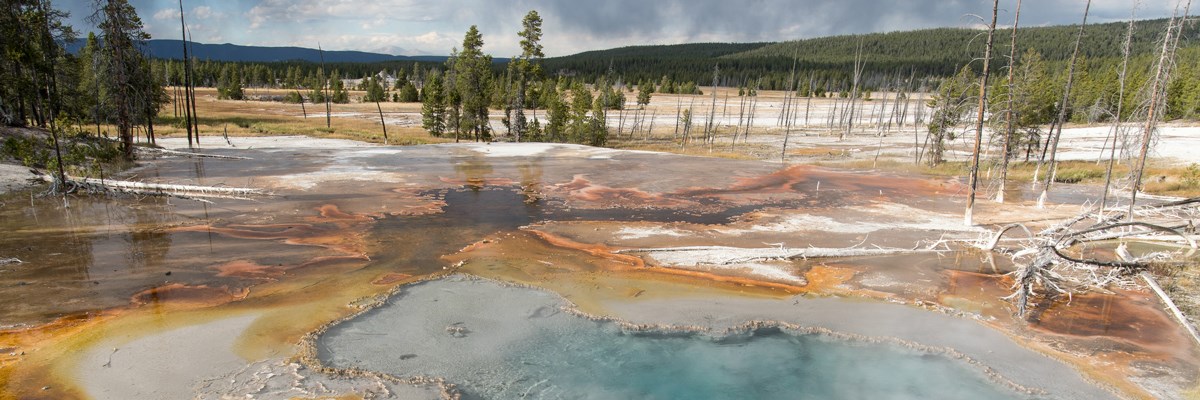
A bubbling blue pool of water with orange edges surrounded by other colorful pools and a forest edge
Image Credit: NPS/Jim Peaco

The images of the hot springs show a spectrum of colors, the Grand Prismatic Spring gets it name from its particularly beautiful range of colors. The thermophilic archaea that live in the springs can survive temperatures up to 92 degrees Celsius. The simple structure of the archaea leads scientists to believe that they have changed very little since they first formed on Earth. Not only are these microbes thermophiles, they are also acidophiles, surviving in pHs of 3 and lower.

There are also bacteria that call these waters home. Some of the bacteria use photosynthesis and even produce chlorophyll, giving the waters a greenish color. Scientists have even found unusual bacteria in the hot springs that can tolerate oxygen and still undergo photosynthesis. These bacteria are alkalophiles, thriving in very basic environments, with pHs greater than 9.

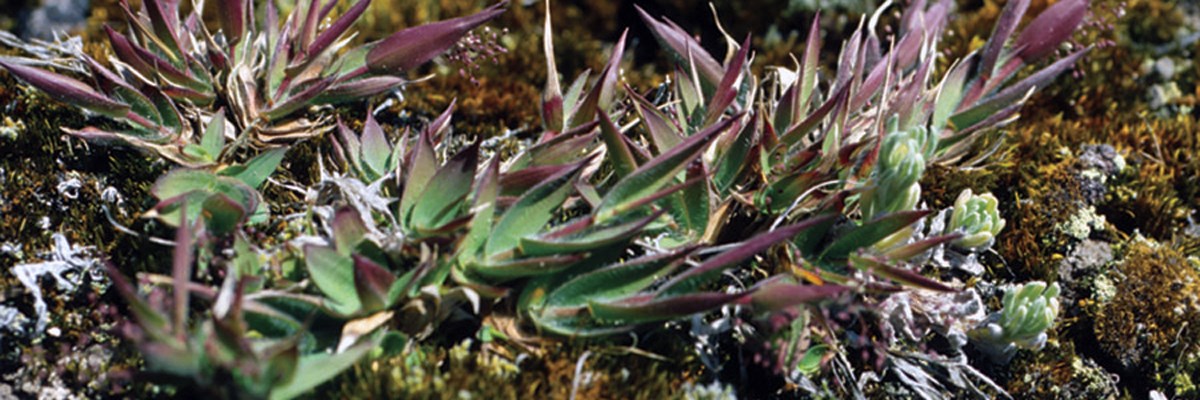
Green vegetation with sharp, purple points
Image Credit: Thermal Biology Institute, Montana State University

The image above shows a type of grass that grows near the hot springs. This plant survives the extreme heat because it is in a symbiotic relationship with a fungus. The fungus lives on the roots of the panic grass. It is only together that these two eukaryotic species can survive heats up to 65 degrees Celsius.

Blog 6: Jupiter Fluid Dynamics

Jupiter has a very thick atmosphere with lots of temperature difference causing strong convective currents. These convective currents and Jupiter’s fast rotation give the planet it’s colorful bands and demonstrate different fluid behaviors.

Close-up view of a storm on Jupiter
Image Credit: NASA/JPL-Caltech/SwRI/MSSS/Matt Brealey/Gustavo B C

The image above, captured by the Juno Spacecraft, shows a storm in Jupiter’s atmosphere. The eddies are similar to that caused by vortex shedding. It is unknown what causes the storms on Jupiter. Scientists theorize that Jupiter’s storms last as long as they do because Jupiter lacks a solid surface close to these storms so the storms do not lose their energy.

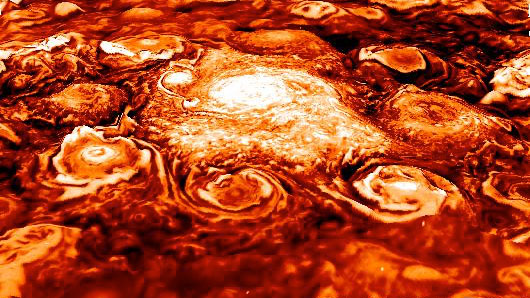
Cyclones at Jupiter's north pole
Image Credit: NASA/JPL-Caltech/SwRI/ASI/INAF/JIRAM


The image above may look like a psychedelic image from a music visualizer, but it is actually an infrared image of Jupiter’s north pole. The cyclonic pattern is comprised of one large central cyclone, which is surrounded by 8 smaller cyclones. Oddly, Jupiter’s south pole has a pentagonal pattern of cyclones. The images and data collected by the Juno spacecraft have allowed astronomers to answer questions about Jupiter, specifically if the storms and winds are only superficial or deep rooted in the planet. It was found that the turbulence does reach significantly into the surface.

Blog 5: Saturn’s Rings

Image Credit: NASA/JPL-Caltech/Space Science Institute

Saturn’s most distinct feature is its stunning rings, visible even through basic telescopes! Thanks to flyby and orbiter missions around the planet, we have wonderful photos of Saturn and its rings. The image above shows the rings on the night side of Saturn, part of which fall into the planet’s shadows and the other part reflects sunlight onto the night side of the planet. Most of the best images of Saturn’s rings, including this one, were captured by the Cassini Mission. The banner image of this post is also from Cassini and shows the rings and planet backlit by the Sun. The reflectivity of rings is due the rings composition and density. The rings are composed of particles of ice and rock, thought to be from asteroids and comets that got obliterated when they came too close to Saturn.


Prometheus and Saturn's rings
Image Credit: NASA/JPL-Caltech/Space Science Institute

The image above shows the thin, more distant ring called the F ring. It also shows a glimpse of Saturn’s moon, Prometheus. Prometheus is the inner orbit shepherd moon for the F ring and Pandora is the outer orbit shepherd moon. These moons keep the F ring in its orbit around Saturn, one pushing inward and the other outward balancing the ring’s location.

Blog 4: The Sirens of Titan

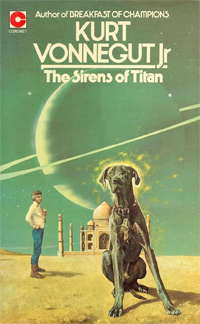
One of my favorite novels is The Sirens of Titan by Kurt Vonnegut. As the title suggests a portion of the novel takes place on Saturn’s moon Titan, though this fiction is more concerned with the philosophical and not the realistic astronomical. I highly recommend it to fans of science fiction.

sirens
Cover Art by Jim Burns

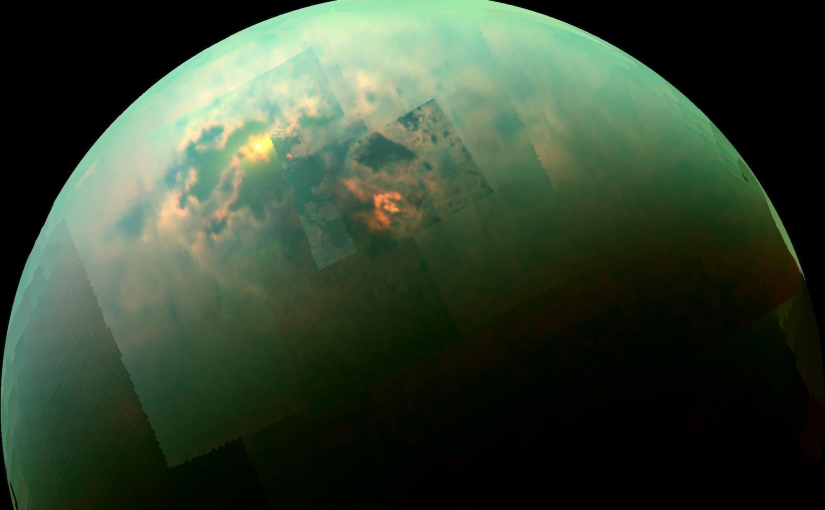
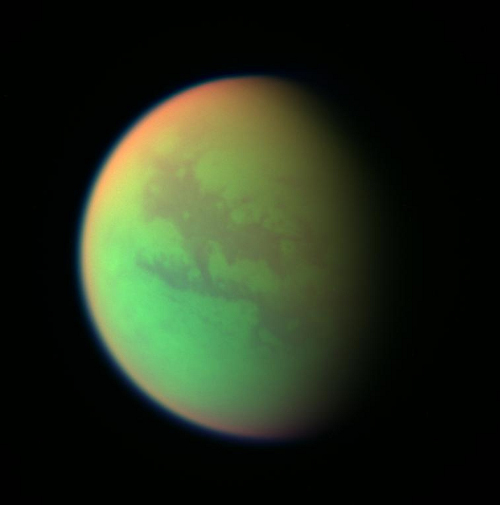
Discovered in 1655, Titan is Saturn’s largest moon and the second largest moon in our solar system. Titan’s rotation is synchronously locked with Saturn and takes just under 16 Earth days to complete its orbit about Saturn. Its surface has been by liquid ethane and methane which make up rivers, lakes, and rain. The extreme cold, -179 degrees Celsius, means water acts like rocks and lava. The lack of craters on Titan’s surface indicate that it experiences erosive and tectonic forces similar to that on Earth.

Image result for titan's surface
Credit: ESA/NASA/JPL/University of Arizona

Titan is unique; it is the only moon in our solar system that has a thick atmosphere. Its atmospheric pressure is 60% greater than Earth’s and Titan’s smaller mass means its atmosphere extends 10 times higher off its surface. Its atmosphere is composed mostly of nitrogen and methane, which are split apart from high energy photons and particles. The split products than reform into organic molecules. Some of the heavier hydrocarbons fall to the surface becoming “sand” in Titan’s dunes.

Credit: NASA/JPL/Space Science Institute

In 1997 NASA launched the Cassini Orbiter and Huygens Probe on a journey to Saturn. Cassini achieved orbit around Saturn in 2004 and the Huygens Probe made its descent to Titan’s surface 6 months later. The Huygens Probe was constructed by the European Space Agency. Weighing approximately 700 pounds, the probe’s payload included 6 scientific instruments designed to collect data on Titan.  NASA Jet Propulsion Laboratory published a video showing animation of the craft’s descent as well as the camera footage it captured. Finally in September of 2017, the Cassini Mission ended when the Orbiter made its final descent into Saturn’s atmosphere.

Blog 3: The Golden Record

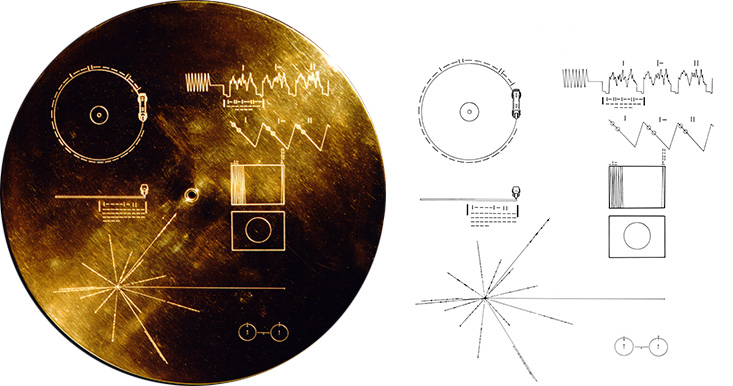
The Voyager Golden Record is a phonograph record that was launched on Voyager 1 and Voyager 2. It contains a variety of sounds and images that are meant to portray the diversity of life and culture on Earth. The 116 images were carefully selected by a team led by astronomer Carl Sagan.  The cover of the record has engravings that are intended to serve as instructions for any extraterrestrial that discovers Voyager.

Golden Record
Credit: NASA/JPL

The instructions on the cover include how to construct the pictures from the signals recorded. The top right image shows the beginning of the recorded signals and how it traces to vertical lines. The circle in the box is a calibration image to indicate the correct horizontal and vertical height ratio. The image in the bottom left is a pulsar map indicating the location of our solar system in relation to 14 pulsars. The image on the bottom right is of a hydrogen atom in its two lowest states. The interval between these two states is used a fundamental time unit.

Voyager Spacecraft
Credit: NASA/JPL

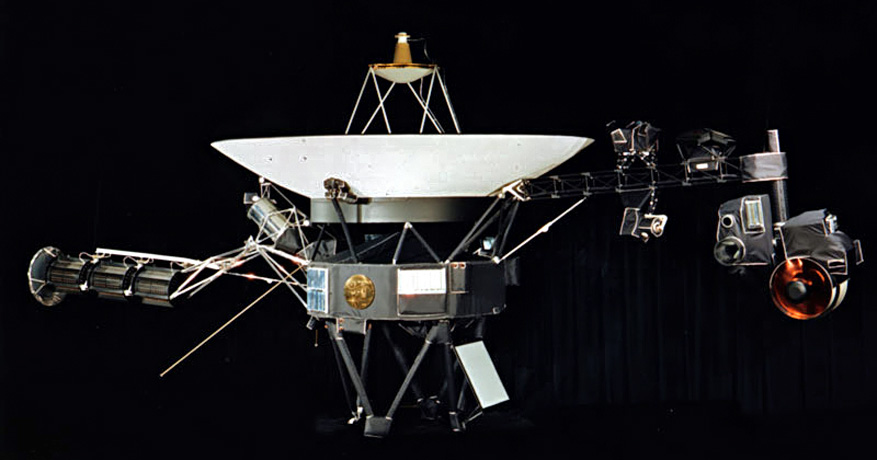
The mission status of Voyager 1 and 2, including their elapsed mission time and their distance from Earth can be seen here. Both have been traveling for over 40 years now and are moving over 30,000 mph. An interesting fact, since Earth travels around the Sun at approximately 67,000 mph, there are times of the year when the distance between Earth and Voyager decreases.

Blog 2: Mont Saint Michel Abbey Tides

The Mont Saint Michel Abbey was built in the 11th century on an island in Normandy, on the north coast of France. The island formed when the landscaped was eroded and granite outcrops remained. Medieval pilgrims nicknamed it, “St. Michael in peril of the sea” because of the extreme changes between high and low tides. This extreme change can be observed in a time-lapse video of the Abbey.  From the video it can be seen that the road that connects the Abbey to the mainland will disappear during high tide. There is roughly a 14 meter difference between the high tide and low ride marks.

The tide moves in so quickly that some pilgrims would drown when they were making their pilgrimage and the tide caught them unaware. Water only reaches the Abbey during spring tides, when the moon and sun gravitational forces are in line. During neap tides, when the moon’s gravitational forces are perpendicular to the sun’s, the sea does not reach the Abbey. There are signs that warn visitors when the tides will rise and there are guides who give tours during low tides.

In the 19th century, a causeway that allowed access to the island even during high tide was constructed. However, this causeway prevented altered how water flowed in the area and caused silt build up. In 2006, the French prime minister began a two part project to restore the island and remove the accumulated silt. One part of the project was the building of a dam on the Couesnon River and the other part was replacing the causeway with a bridge that allows water to flow freely.

Historical Astronomers in Context

Johannes Kepler: December 27, 1571 – November 15, 1630

Johannes Kepler made important contributions to astronomy, primarily from his studies of celestial mechanics. From his calculations and Tycho’s observations, Kepler developed his three Laws of Planetary Motion. First, “Planets move in ellipses with the Sun at one focus.” Second, “The radius vector describes equal areas in equal times.” Third, “The squares of the periodic times are to each other as the cubes of the mean distances.”

In 1582, Catholic Pope Gregory XIII introduces the Gregorian Calendar, and is still used today. It replaced the Julian Calendar and introduced the contemporary concept of the leap year.

In 1607, the first permanent British colony on the American Mainland is established, Jamestown, Virginia. The 104 surviving passengers of the Susan Constant, Godspeed and Discovery landed on the Virginian coast in April of 1607.

William Shakespeare: April 26, 1564 – April 23, 1616. Shakespeare is a well-known playwright and poet that is credited for his many contributions to language and theater. His works are still performed internationally and have inspired many theatrical figures.

Reflection: It was interesting to see the astronomy, artistic, and political developments that occurred during this historical era. It is difficult to put the time in perspective since it was relatively long ago in human history. Since scientific, artistic, and political figures are usually studied in separate subjects, it is unusual to see how there is overlap between the significant developments.

Blog 1: Total Solar Eclipse 2017

usa_eclipse_map
Image by NASA Viz

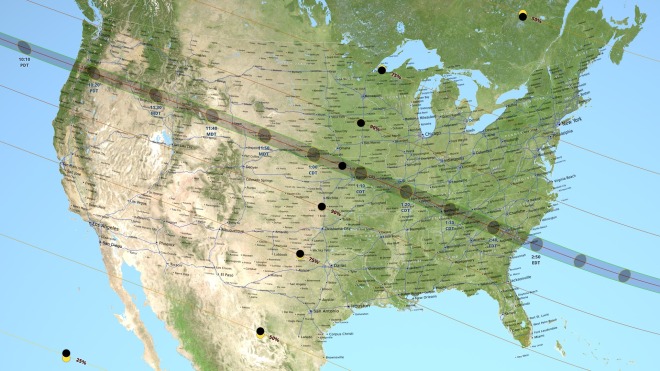
This image was made by the NASA Visualization Explorer to show the path of totality of the 2017 solar eclipse. A solar eclipse occurs when the moon passes between the sun and the earth. As the moon blocks the sun, it casts on a shadow on earth that travels west to east very quickly due to the combination of Earth’s rotation and the moon’s orbit. It becomes very dark in this shadow and the path that this shadow travels is called the path of totality because people observing from this path can witness a total eclipse. Unlike a lunar eclipse which can be observed from any location, the observable location of a solar eclipse is quite small.

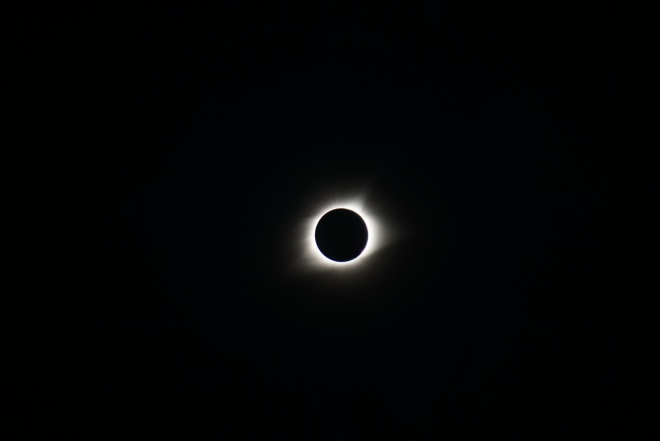
Those of us in Nashville were lucky enough in 2017 to be in this path of totality. This phenomenon was spectacular to observe, not only because of the awe-inspiring visual but the strange influence it had. The Cosmic Perspective textbook makes mention of this influence but it is surreal to experience; birds returning to their nests and crickets chirping as they would at nighttime.

C6E51F82-4EE9-411E-95D9-1E277FB38F57
Photo taken by personal friend in Hendersonville, TN